The Desume Reuse Kit: one stall, every fair
A modular exhibition stand we design once around your brand, then rebuild for each show you take part in, in Delhi, across India and abroad. Fewer stalls in the skip, a stronger and more familiar brand presence, and lower costs from the second show on.
Why a kit, not a one-off stall
Most custom stalls in India are built for a three-day show and broken up on the last night. A brand that exhibits four or five times a year pays for design, carpentry and paint again every time, and ends up with a different-looking stall at every fair.
The Reuse Kit turns your stall into something you own. We design a set of pre-finished panels, counters, display units and lighting that bolt together, pack flat into a small tempo or a shipping crate, and rebuild in a new shape to suit each stall size and number of open sides.
Compact kit: 6 to 9 sq m
For shell-scheme and small bare-space stalls. A back wall, a counter and one or two display units, which can also be set up as a pop-up in a store or at an event.
Standard kit: 12 to 18 sq m
For brands at trade fairs and design weeks. Walls that can be rearranged for one, two or three open sides, a demo or meeting corner, and storage.
Pavilion kit: 36 sq m and up
For flagship shows. A walk-through layout in rooms that can be split into two smaller stalls for regional fairs in the same season.
Graphics and refresh
Each new show needs only new graphics and, if you like, a few new pieces. We plan the kit so it can be refreshed for a new collection without rebuilding it.
Designed as rooms, built as parts
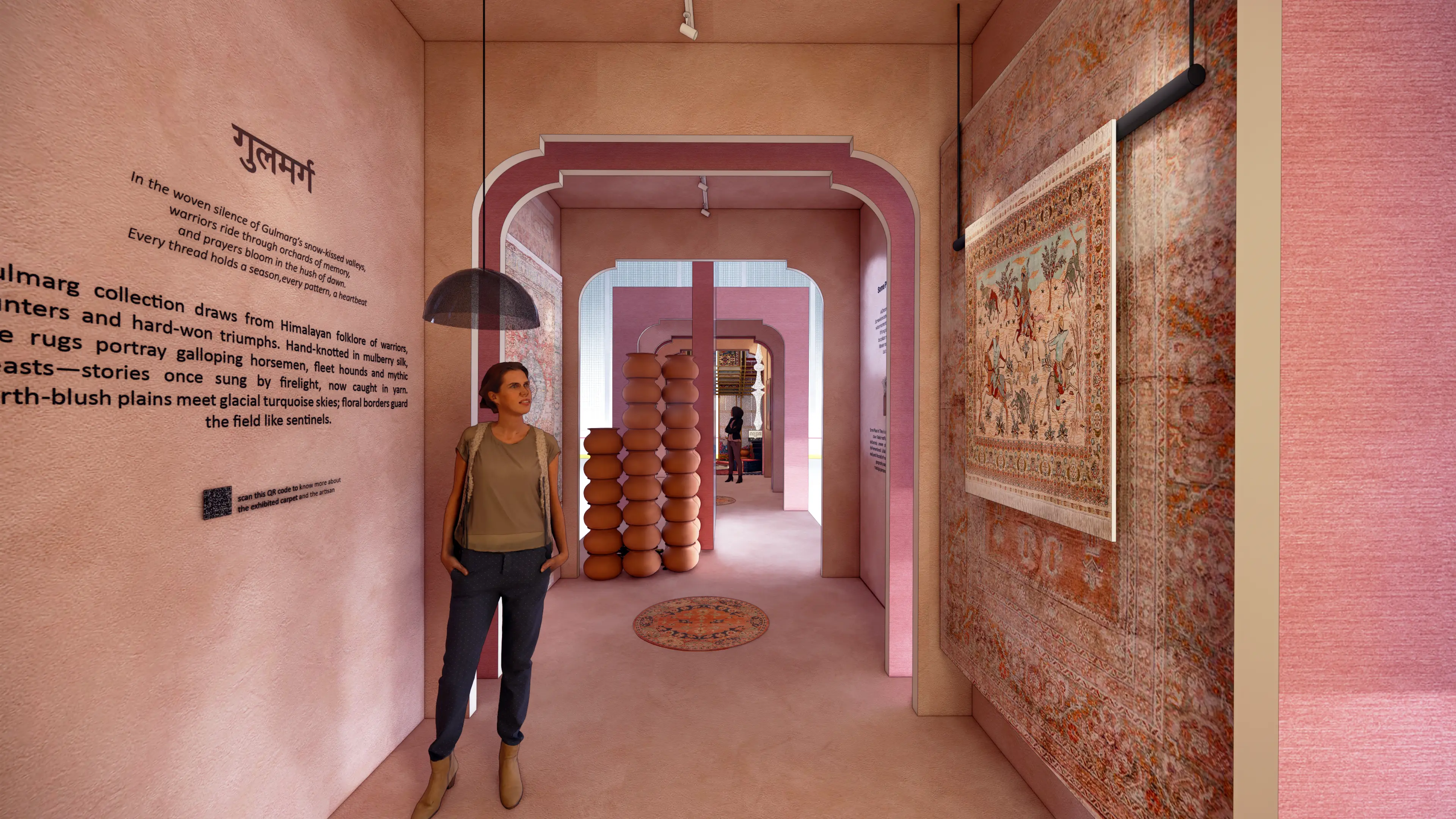
Our pavilion designs for the Jaipur Rugs competition were planned as a sequence of rooms built from repeated arches, plinths and display frames. That way of thinking is the basis of every Reuse Kit.

How the kit pays for itself
The first build costs a little more than a one-off stall, because the parts are made to last and to be taken apart. From the second show on, you mostly pay for transport, an install day, storage and new graphics.
Every part is listed in a kit manual with its size, weight and position for each layout, so any trusted fabricator can put it up and take it down without guesswork. We specify fire-retardant boards and fabrics that Indian venues usually require and avoid materials that cannot be reused or recycled.
Because the stall looks the same at every fair, visitors and buyers start to recognise you from across the hall.
How a project runs
Show calendar
You share the fairs you plan to attend this year, the stall sizes and open sides, and what you need to show and store.
Kit design
We design the kit and show it in 3D in two or three layouts, so you can see how it changes from a corner stall to an island.
Build and manual
We prepare working drawings, compare fabricator quotes, check the build at the workshop and write the kit manual.
Every next show
For each show we send a new layout and graphics plan, and coordinate the install if you need us there.
Before starting Desume Studio, our founders Summy Kumar and Arathi Anand worked on exhibitions for India Art Fair, Serendipity Arts Festival and the Gujral Foundation alongside other design practices.
Questions we often get
How many times can a modular exhibition stand be reused?
With good storage and care, the main structure usually lasts several seasons of shows. Graphics and surfaces that people touch most often may need refreshing sooner. We design the kit so worn parts can be replaced one at a time.
Does a reusable stand look like a standard shell-scheme stall?
No. The kit is designed for your brand, with your materials, colours and display needs. It is modular inside, but it looks and feels like a custom stall.
Can one kit fit different stall sizes?
Yes. We plan two or three layouts from the start, for example a 9 square metre corner stall and an 18 square metre island, and the kit manual shows how to build each one.
Where is the kit stored between shows?
It packs flat. Many brands keep it at their own warehouse or with the fabricator. We plan the packing list and crate sizes so it fits a small tempo or a shipping crate.
Can we take the kit to fairs outside India?
Yes. We can plan the parts to fit standard crates and check the venue's rules for fire safety and rigging. Many brands use the same kit for Indian and Gulf fairs.
Exhibiting more than once next year?
Send us your 2027 fair calendar and stall sizes. We will reply with a kit idea and a comparison of one-off stalls against a Reuse Kit.
Share your fair calendar